Last updated: October 21, 2026
- Original name: South Pittsburg Municipal Hospital (SPMH)
- Current name: Old South Pittsburg Hospital Paranormal Research Center (OSPHPRC)
- Address: 1100 Holly Avenue, South Pittsburg, TN 37380
- Opened: 1959, founded by four physicians
- Size: About 68,000 square feet, with additions over the following decades
- Closed as a hospital: 1998 in most accounts (1995 in the South Pittsburg Historic Preservation Society's history)
- Doctors honored on a Chapel on the Hill window: Viston Taylor, Russ Adcox, Jimmy Havron, Bill Headrick, Gene Ryan, and John Hackworth
- Purchased by current owner: 2018, by Ronnie Dee
- Reopened as a paranormal research center: 2019

The Old South Pittsburg Hospital opened in 1959 as the South Pittsburg Municipal Hospital (SPMH), the town's own general hospital. It served South Pittsburg and the surrounding area until the 1990s, when its patients and services moved to a new hospital in Jasper. The empty building then passed through private and federal hands, picked up a reputation as a haunted building, and since 2019 has operated as the Old South Pittsburg Hospital Paranormal Research Center (OSPHPRC), an overnight investigation venue that has appeared on at least five national paranormal-television programs. It is one of two Marion County properties whose second life is built around a haunted reputation, the other being the Hales Bar Dam powerhouse.
Medical care before the hospital
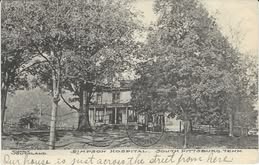
South Pittsburg had a hospital briefly half a century before the Municipal Hospital opened. According to the South Pittsburg Historic Preservation Society's “History in Pictures” homes page, a late-1907 postcard shows the Simpson Hospital at the corner of Oak Avenue and Fourth Street, in a building said to have served as headquarters for the Old English Company that built the town during its late-1870s boom. The hospital operated for only about three months: in early 1908, Dr. J. A. Simpson moved his family out of state. The building became the Bert Cook family home and was later owned by Dr. and Mrs. William L. Headrick; a Dr. Bill Headrick is among the physicians honored on the Municipal Hospital doctors' window described below. A 2002 photograph on the Society's page shows the building still standing as a private home, altered to the point that it little resembled the hospital on the postcard.
After the Simpson Hospital closed, South Pittsburg's medical care came largely from doctors in private practice. The 1911 Who's Who in Tennessee lists Dr. Charles L. Hackworth, a Chattanooga medical graduate of 1901, practicing medicine in the town. Two of the longest-serving doctors were Black physicians whose careers the South Pittsburg Historic Preservation Society's “History in Pictures” people page records. Dr. W. J. Astrapp, pictured there in the 1920s, treated South Pittsburg residents and patients from outlying communities for several decades and mentored the younger doctor who took over his practice. Astrapp died a few months before that successor, Dr. Hiram Beene Moore, opened his South Pittsburg practice in January 1945. Astrapp also served on the committee that established the town's high school for Black students, now remembered as McReynolds High School.
When Moore began practicing, according to a 1999 Associated Press profile, “There was no hospital,” and he often traveled alone to see patients on house calls. The same profile notes that the house calls became less frequent after “a hospital was built.”
The nearest institutional care in the first half of the century was at the cement-company town of Richard City, which the Tennessee Encyclopedia describes as a company town complete with company-built homes and a hospital. There, Dr. J. W. Kirkpatrick opened an infirmary at the Dixie Inn and later built the larger Dixie Hospital on the road to the Dixie Portland Cement plant, which the South Pittsburg Hustler called in 1931 “one of the best and most modernly equipped institutions of its kind in the entire Chattanooga territory” (as quoted in Kelly Wilkerson's 2003 Middle Tennessee State University thesis on Richard City; see the Richard City page).
The hospital era
According to the South Pittsburg Historic Preservation Society, “South Pittsburg established a Municipal Hospital in 1959.” Jerry Summers' 2020 Chattanoogan column on the building records that it was built by four physicians at 1100 Holly Avenue and served as the hospital for South Pittsburg and the surrounding area. The building's current operator gives its size as about 68,000 square feet and notes that many additions were built over the following decades. The building has a basement level and upper floors; the third floor figures in most of its later ghost stories.
The physicians' practice behind the hospital is older than the building. According to an account shared by David Head, the practice began in Bridgeport, Alabama, as the Tri-City Clinic. Its doctors later moved the clinic to South Pittsburg, into rented space on the second floor of the South Pittsburg Hustler newspaper office, and when the new hospital was built they moved the clinic into it, where it kept the Tri-City Clinic name.
The four founding physicians are not named in Summers' column or the operator's history. The South Pittsburg Historic Preservation Society's restored Chapel on the Hill carries a stained-glass window inscribed “South Pittsburg Municipal Hospital Doctors” that names six physicians who practiced there: Viston Taylor, Russ Adcox, Jimmy Havron, Bill Headrick, Gene Ryan, and John Hackworth. The window honors the hospital's doctors generally rather than the founding four, and not all six were necessarily on staff at the 1959 opening.
A separate window in the same chapel honors Prof. J. B. and Grace Dean Havron, who were educators rather than physicians. The Society's Voices of South Pittsburg oral-history series includes an interview with Cindy Patrick about her grandparents, who worked at South Pittsburg High School, and her father, Dr. James Havron, whose name matches the “Jimmy Havron” of the hospital window.
Closure and the move to Jasper
By the 1990s the hospital was in corporate hands. The Preservation Society's history says that after the hospital was sold, “the new corporate owners eventually closed the hospital in 1995 as all health care services were in a new hospital facility on I-24.” Most other accounts, including Summers' column and the operator's history, give the closing year as 1998.
The replacement was Grandview Medical Center in Jasper, which Capella Healthcare describes as a 70-bed hospital built in 1998 with more than 100,000 square feet. The Chattanooga Times Free Press described Grandview in 2014 as the hospital “which was started in South Pittsburg Hospital,” marking it as the same operation in a new building. HCA's TriStar Division bought Grandview from Capella effective March 1, 2014, and it operates today as Parkridge West Hospital at 1000 Tennessee Route 28 in Jasper.
Primary care has since returned to South Pittsburg in a smaller form. Erlanger's Primary Care – Marion County practice at 520 East 12th Street offers checkups, chronic-disease care, lab work, and minor procedures for patients across Marion County and nearby north Alabama.
Storage, investigators, and a haunted reputation
After the hospital closed, the building was bought by a private owner and used primarily for storage, according to a 2024 Chattanooga Pulse feature. That owner later opened it to paranormal investigators. A 2016 episode of Syfy's Paranormal Witness, “The Night Ward”, featured a former clinical lab worker's accounts of unexplained events during his years at the hospital, along with the owner's daughter, who managed the property for her father.
Investigators were using the building by 2010, when one paranormal blogger first investigated it, and television followed. The Travel Channel's Paranormal Challenge sent two Tennessee teams into the “abandoned hospital” in an episode aired August 12, 2011, and the Tennessee Wraith Chasers, one of those teams, returned for Destination America's Ghost Asylum (Season 3, Episode 2, aired April 10, 2016). The same blogger reported in January 2019 that the building had been shut down for a time and described mold, dust, and debris inside.
The Old South Pittsburg Hospital Paranormal Research Center

The current owner, identified in press coverage as Ronnie Dee, bought the hospital in 2018, according to the Chattanooga Pulse; Summers reports that the new owners bought the property from the Internal Revenue Service. In a March 2019 comment, Dee described stripping affected areas down to the brick to remove the mold and aiming to open “by summer” of 2019 under the new Paranormal Research Center name. The first event after the purchase, a Tennessee Wraith Chasers investigation, was held on March 23, 2019, with part of the proceeds going toward the remodel.
OSPHPRC runs as a paid investigation venue rather than a traditional museum: visitors book multi-hour or overnight sessions and conduct their own investigations. In Summers' 2020 column, South Pittsburg City Administrator Gene Vess said the new owners had “corrected the problems incurred with the former owners,” including mold and zoning issues, and “appear to be running a good business as reflected by the increasing sales tax revenue to the city.” The Pulse reports that the owner sees the venue as a way of preserving the hospital's history while letting others explore its paranormal side.
Television coverage continued under the new ownership. The Travel Channel's Destination Fear devoted its second episode, “Old South Pittsburg Hospital,” to the building on November 2, 2019, and Kindred Spirits (Season 4, Episode 12, “The Body Box,” 2020) brought Amy Bruni, Adam Berry, and Chip Coffey to investigate.
Reported phenomena
The phenomena below come from the venue's tour lore and from press and television accounts. They are part of the building's current story rather than independently verified events. Summers' column lists the most often named figures: a “Naughty Nurse” in the basement; “Buddy,” a two-year-old child described as playful and active on the third floor; a male doctor; a janitor; a female nurse; and a male figure about seven feet tall, possibly a former surgeon. The Pulse adds that staff count 40 to 50 “residents,” including former doctors, patients, and children, and describes reports of disembodied voices, tall shadow figures, crying babies, full-body apparitions, and doors opening and closing. Kindred Spirits added a dog-like entity its investigators called “the Creeper.”
The hospital's haunted reputation is also covered, alongside the Hales Bar Dam powerhouse, on the Folklore and the paranormal page.
Significance to South Pittsburg
For roughly four decades the Municipal Hospital gave South Pittsburg what Dr. Moore had lacked when he began practicing in 1945: a hospital in town. Its closure was part of a wider regional shift that moved services up the valley toward Jasper and the interstate, the same shift traced on the South Pittsburg page. The building's paranormal second life has kept it occupied and in use since 2019.
Related
About South Pittsburg →
About Jasper →
About Richard City and the Dixie Hospital →
Dr. Hiram Beene Moore →
Folklore and the paranormal in Marion County →
About Hales Bar Dam →
Sources
- South Pittsburg Historic Preservation Society — Home page history of South Pittsburg (1959 Municipal Hospital; 1995 closure by corporate owners)
- South Pittsburg Historic Preservation Society — Chapel on the Hill (donor windows naming the SPMH doctors and the Prof. J.B. & Grace Dean Havron window)
- South Pittsburg Historic Preservation Society — Voices of South Pittsburg (Cindy Patrick interview summary)
- South Pittsburg Historic Preservation Society — South Pittsburg History in Pictures: Homes (Simpson Hospital, 1907–1908; photos courtesy of Dennis Lambert)
- TNGenWeb — Who's Who in Tennessee (1911), South Pittsburg: Charles L. Hackworth, physician
- Community contribution (via David Head, 2026): Tri-City Clinic origins in Bridgeport, Alabama, and its move to the South Pittsburg Hustler building and then the hospital
- South Pittsburg Historic Preservation Society — South Pittsburg History in Pictures: People (Dr. W. J. Astrapp and Dr. Hiram Beene Moore)
- Rachel Zoll, “Black Doctor In White Town Made Patients Color-Blind,” Associated Press / Seattle Times, October 17, 1999
- Tennessee Encyclopedia — Richard City (Kelly Wilkerson)
- Kelly Wilkerson, “Richard City, Tennessee: Home, Community, and Paternalism in a Southern Company Town, 1900–1985,” M.A. thesis, Middle Tennessee State University, 2003 (Dixie Hospital; quoting the South Pittsburg Hustler, July 16, 1931)
- Jerry Summers, “South Pittsburg's Old Haunted Hospital,” Chattanoogan, June 14, 2020
- Old South Pittsburg Hospital Paranormal Research Center — About OSPHPRC
- Patty Leon, Chattanooga Pulse feature on the Old South Pittsburg Hospital, October 3, 2024
- Haunt Jaunts, “Is the Haunted Old South Pittsburgh Hospital Back Open for Business?” January 20, 2019
- Haunt Jaunts, “Old South Pittsburg Hospital Update and TWC Investigation,” March 22, 2019 (with owner's comment)
- Capella Healthcare — Grandview Medical Center, Jasper
- Capella Healthcare — HCA's TriStar Division purchases Grandview Medical Center (March 3, 2014)
- Chattanooga Times Free Press — “HCA to buy Grandview Medical Center in Jasper, TN,” January 14, 2014
- Parkridge West Hospital, Jasper
- Erlanger — Primary Care, Marion County (South Pittsburg)
- Syfy — Paranormal Witness, “The Night Ward” episode recap (2016)
- Wikipedia — Paranormal Challenge (Episode 8, “Old South Pittsburg Hospital,” 2011)
- Wikipedia — Ghost Asylum (Season 3, Episode 2, “Old South Pittsburg Hospital,” 2016)
- Wikipedia — Destination Fear (Season 1, Episode 2, “Old South Pittsburg Hospital,” 2019)
- TVmaze — Kindred Spirits, Season 4, Episode 12, “The Body Box” (2020)
- Photographs by Tyce H, 2026 (front of the building, OSPHPRC monument sign).