Last updated: September 22, 2026
- Period: the 1890s through the 1930s, before organized school athletics dominated county sport
- Known clubs: the Dixie Portland company team at Richard City; the Marion Athletic Club at Guild, called “the Lock and Dam team” in the press; the South Pittsburg town team, playing by 1897; a Jasper town team; later Penn-Dixie company teams
- Grounds: a company diamond at Richard City (1907); a ball ground at South Pittsburg; a new park at Jasper (1912)
- Best-documented season: 1912
Marion County's sporting reputation now rests on high-school football, where three programs have carried home state championships. That distinction is a comparatively recent one. For the first third of the twentieth century the county's organized sport was baseball, and the teams that played it were not schools but workplaces and towns: a cement plant, a dam construction camp, and the business districts of South Pittsburg and Jasper. The clubs drew on whoever in the payroll or the town could play, competed against neighbors within a steamboat or rail journey, and drew crowds large enough to be worth counting in the newspaper.
This was ordinary for the period. Tennessee's professional game was already well established, with Chattanooga, Nashville, and Memphis among the charter members of the original Southern League founded in 1885. Beneath that professional tier sat a broad amateur and semiprofessional layer of company and town nines, and it is that layer the surviving Marion County record documents. That record reaches back at least to 1897, when South Pittsburg already fielded a town team.
The company diamond at Richard City
The cement company built a ball ground of its own. Dixie Portland Cement began building its plant and its company town at Richard City in the first decade of the century, and among the amenities it built for its workforce was a baseball diamond, constructed in 1907, for a team that competed against other local squads. Kelly Wilkerson's 2003 Middle Tennessee State University thesis on Richard City places the diamond alongside the swimming pool, the tennis court, the Dixie Inn hotel, the commissary, and the company hospital as part of a deliberate program of company-provided recreation.
The company's own president played. Richard Hardy, for whom Richard City was named, had pitched varsity baseball at the University of Michigan in the early 1890s, and per Wilkerson he often pitched for the company team. Fourth of July celebrations at Richard City paired fireworks with baseball games, with automobiles barred from running in the town for the holiday. A man who ran a cement plant and later served as mayor of Chattanooga taking the mound for his own employees is a fair picture of how little distance there was between the company and the club.
The Marion Athletic Club at Guild
Upriver, a second workforce was assembling. The Chattanooga and Tennessee River Power Company began construction on Hales Bar Dam in October 1905, and the project eventually employed over five thousand men, requiring the construction of villages to feed and house them. One of those, on the north bank, was Guild. It had company housing, a post office that opened in 1906, and, by 1912, a baseball team good enough to be photographed.
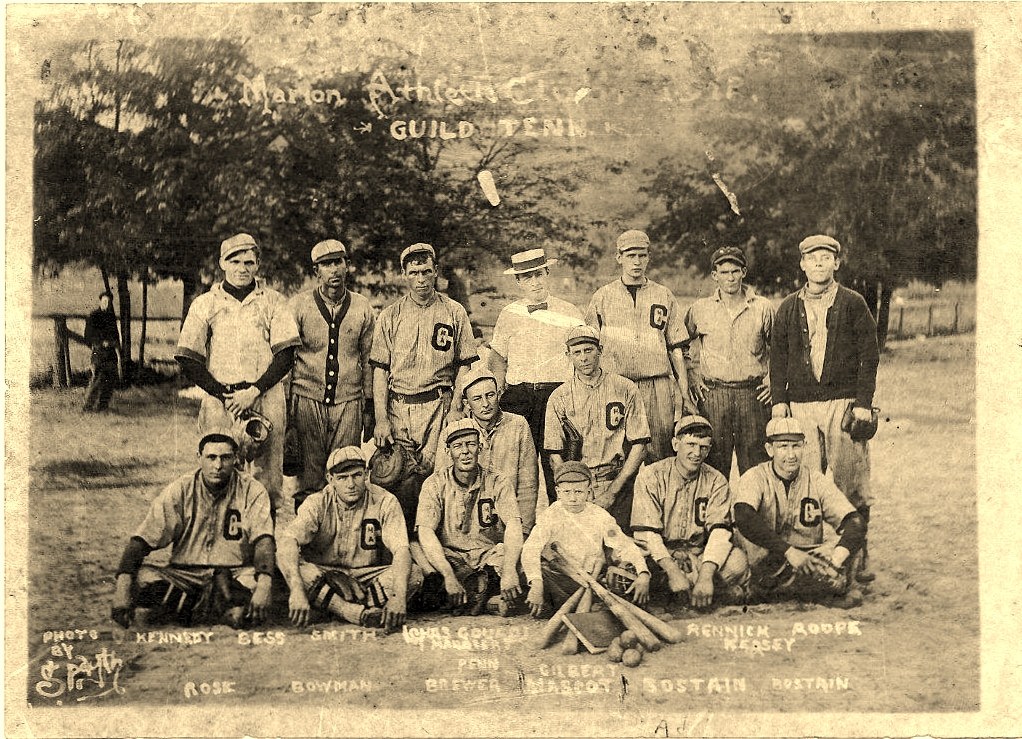
The print is lettered Marion Athletic Club and Guild, Tenn. across the sky, with 1912 at the end of the first line, and the players' surnames run along the bottom edge in the same hand. Fourteen names are lettered. The man in the white shirt and straw boater standing at the center of the back row is marked Chas Gould, manager; the small boy seated at the front is marked Gilbert, mascot. Two of the players share the surname Bostain. They were the brothers Addison and Earl Bostain, of a family then living at Whiteside, where Addison had been working as a carpenter for a coal mine before moving to the dam.
The club that the photograph calls the Marion Athletic Club is the same one the press called the Lock and Dam team, after the navigation lock built into the dam alongside the powerhouse. The two names attach to the same men: a manager named Gould, and a Bostain who pitched.
April 26, 1912: the Lock and Dam at South Pittsburg
On Friday, April 26, 1912, the Lock and Dam team came downriver to play the South Pittsburg town team. The following week's South Pittsburg Hustler of Friday, May 3, 1912 gave the game the left-hand columns of its front page under the headline Lock and Dam Team Kalsomined, and called it, with one exception, the finest game ever played in the city.
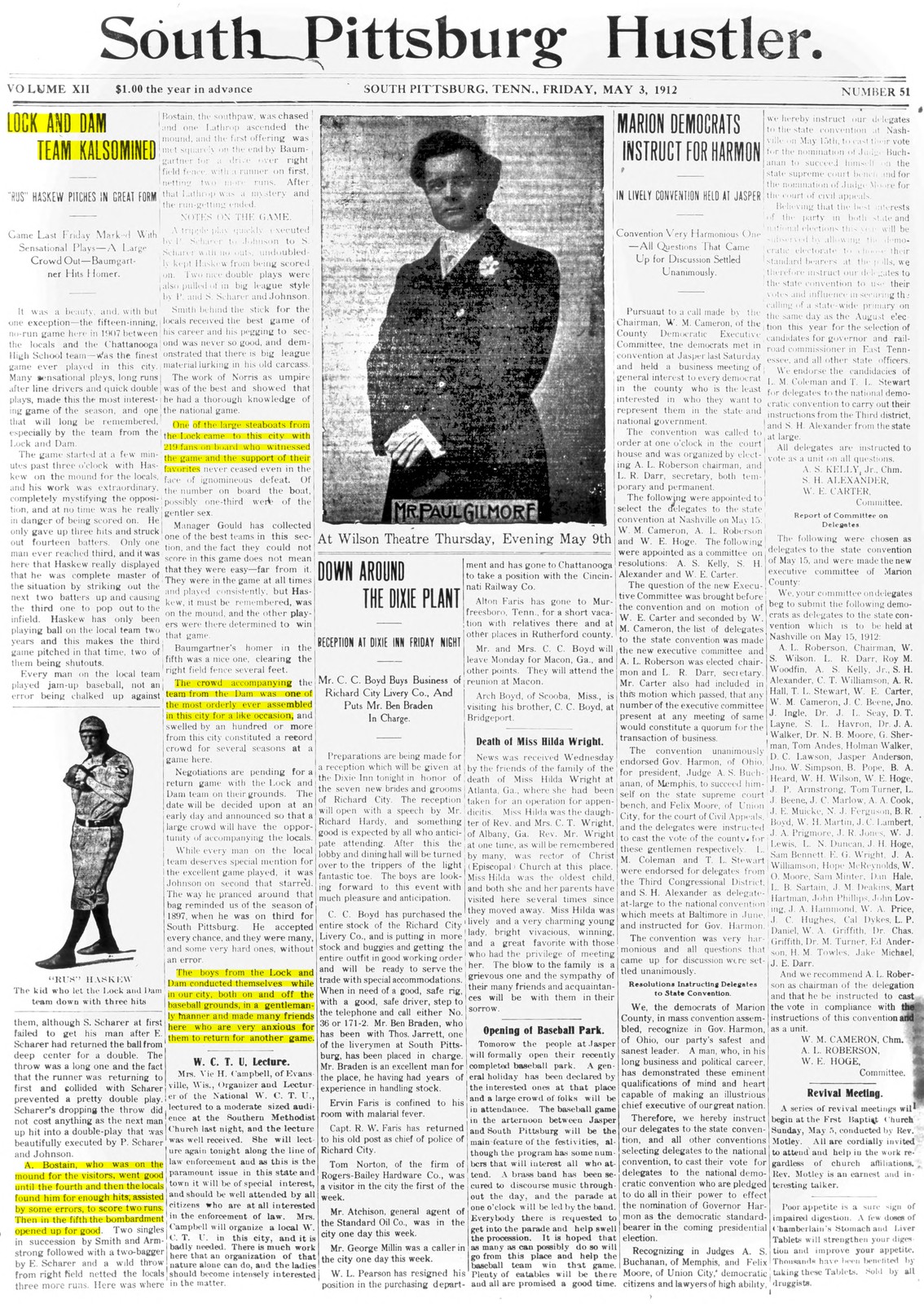
The local pitcher was “Rus” Haskew, captioned by the paper as “the kid who let the Lock and Dam team down with three hits.” He struck out fourteen, allowed only one runner to reach third, and when that runner got there, struck out the next two batters and made the third pop out to the infield. Haskew had been playing on the local team for two years, and the paper counted this as only his third game pitched in that time, two of them shutouts.
A. Bostain, the southpaw, started for the visitors and held until the fourth, when South Pittsburg found him for enough hits, helped along by errors, to score two. In the fifth the locals scored three more on two singles, a two-base hit by E. Scharer, and a wild throw from right field. Bostain was pulled, and Lathrop took the mound; his first offering was met square on the end by Baumgartner, who drove it over the right field fence with a runner on for two more runs. After that, by the paper's account, “Lathrop was a mystery and the run-getting ended.”
The defense was what the writer remembered. A triple play, executed by P. Scharer to Johnson to S. Scharer with no outs, by the paper's account undoubtedly kept Haskew from being scored on, and two more double plays were turned in what the paper called “big league style.” Johnson at second was singled out as the star of the game, accepting every chance without an error, in a way that reminded the writer of the season of 1897, when Johnson had played third for South Pittsburg. The final was a shutout; the headline's “kalsomined” was the period's term for it.
Two hundred and nineteen fans by steamboat
The detail that fixes the game in its place and time is how the visitors arrived: the Lock and Dam team and its supporters came down the Tennessee by boat. One of the large steamboats from the Lock, the paper reported, came to the city with 219 fans on board, of whom about a third were women.
They lost, and the Hustler was gracious about it. The visitors' support of their favorites, it wrote, “never ceased even in the face of ignominious defeat.” The crowd that came with the team was “one of the most orderly ever assembled in this city for a like occasion,” and swelled by a hundred or more local people it made a record crowd for several seasons at a game there. The boys from the Lock and Dam, the paper added, conducted themselves “both on and off the baseball grounds, in a gentlemanly manner and made many friends here who are very anxious for them to return for another game.” Negotiations were pending for a return game on the Lock and Dam's own grounds, with the date to be announced early enough that a large crowd could accompany the locals back upriver.
The same account supplies the one earlier benchmark the paper thought worth measuring against: a fifteen-inning, no-run game played at South Pittsburg in 1907 between the locals and the Chattanooga High School team, which in the writer's judgment was the only finer game the city had seen.
Jasper opens its park
The day after that front page went to press, the county seat opened a ballpark. Jasper formally opened its recently completed baseball park on Saturday, May 4, 1912, as the same front page announced. A general holiday had been “declared by the interested ones at that place,” a brass band was “secured to discourse music throughout the day,” and a parade at one o'clock was to be led by the band, with everybody there “requested to get into the parade and help swell the procession.” The feature of the afternoon was a game between Jasper and South Pittsburg. The Hustler, a South Pittsburg paper, closed its notice hoping “that as many as can possibly do so will go from this place and help the baseball team win that game.”
After the dam
Hales Bar was finished in 1913 and the construction workforce dispersed. By his grandson's account of the family's years there, Addison Bostain stayed in the county a few years more, long enough for his son to be born at Guild in 1914 and to spend his early childhood in company housing, before leaving in the spring of 1918 for the Wilson Dam project at Muscle Shoals, Alabama. The club belonged to the village, and the village emptied with the job.
Company baseball in the county did outlast it. At Richard City the cement plant's team continued under Pennsylvania-Dixie ownership after the 1926 merger, and the plant fielded squads that were still being photographed in the late 1920s and 1930s.
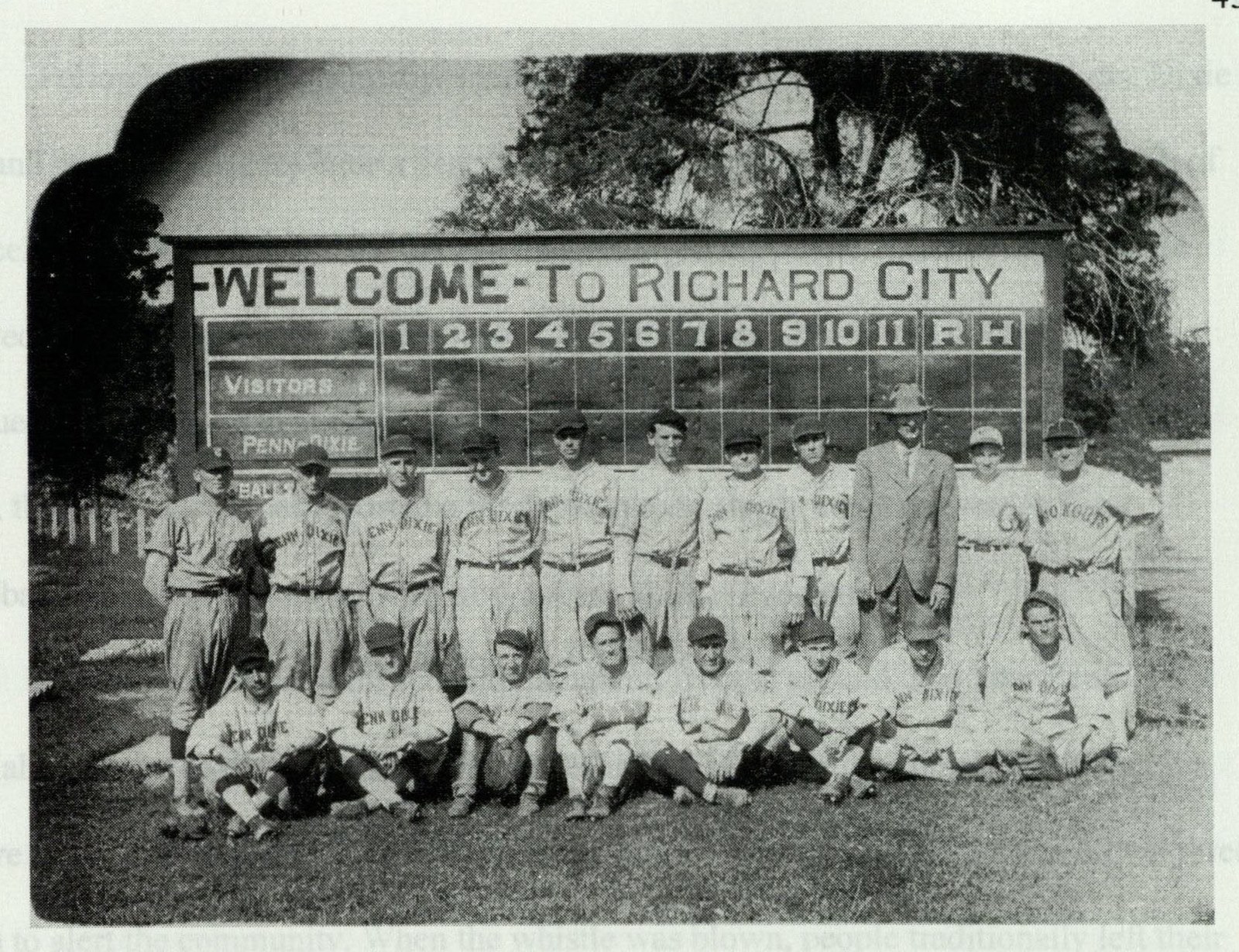
By the time those teams stopped playing, the county's organized sport had shifted onto the school campuses, where Marion County athletics has stayed since. The company diamond at Richard City and the ball ground at Guild belong to an older arrangement, in which the team a man played for and the payroll he drew from were the same institution.
Related
- Hales Bar Dam →
- Haletown & Guild →
- Richard City →
- Whiteside →
- Richard Hardy →
- Marion County Athletics →
- Dixie Portland Cement →
- Civic Life →
Sources
- South Pittsburg Hustler, Volume XII, Number 51, Friday, May 3, 1912, page 1 — “Lock and Dam Team Kalsomined” and “Opening of Baseball Park.” Community contribution, courtesy of Ronnie Bostain
- Marion Athletic Club team photograph, Guild, Tennessee, 1912. Community photo, courtesy of Ronnie Bostain
- Ronnie Bostain, Addison Bostain Sr.: Hydroelectric Dam Construction Projects, family history (the Bostain brothers at Guild, the 1910 census entry at Whiteside, the birth of a son at Guild in 1914, and the 1918 departure for Wilson Dam). Community contribution, 2026
- Kelly Wilkerson, Richard City, Tennessee: Home, Community, and Paternalism in a Southern Company Town, 1900–1985, M.A. thesis, Middle Tennessee State University, May 2003 (the 1907 diamond, Hardy pitching for the company team, and the Fourth of July games)
- Tennessee Encyclopedia — Hales Bar Dam (October 1905 construction start, over five thousand men, the worker villages)
- Tennessee Encyclopedia — Minor League Baseball (the 1885 Southern League and its Tennessee charter members)
- Tennessee Encyclopedia — Richard City (Kelly Wilkerson, 2018)